

The chronicles of narmo, p.1
The Chronicles of Narmo, page 1


Contents
Cover
About the Book
Title Page
Dedication
Introduction
1 ‘Twas Two Days After Christmas and All Through the House, Everyone was Bored, Including the Mouse . . .
2 The Narmos Get Radical
3 Cordon Bleurgh
4 The Trip to the Zoo, and the Strange Creatures
5 The Child, the Egg and the Wardrobe
6 The Off-White Wedding
7 The Bat
8 Lily and the Bat Correspond
9 Scotland the Brave
10 Aggy and Alison Discuss
11 The Jumble Sale
12 Whoops Apocalypse
About the Author
Also by Caitlin Moran
Copyright
About the Book
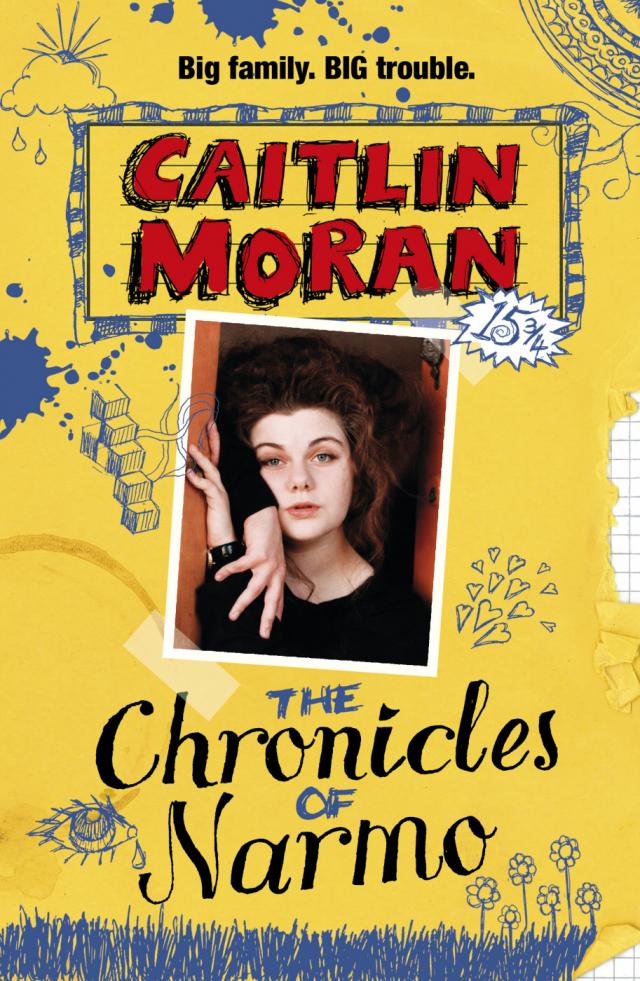
Morag Narmo really doesn't want to go to school any more. She and her siblings would rather feed their heads into the waste-disposal unit than ‘do the academical’. So they are all stunned when their parents whisk them out of school and embark on a home-schooling experiment. But with five children, two unruly pets and some extremely eccentric attitudes, life soon descends into chaos . . .
Razor-sharp and laugh-out-loud funny, The Chronicles of Narmo show us how before Caitlin Moran knew How to be a Woman, she had to find out How to be a Girl.
For Gillian Anne Rowley – who knew I couldn’t be an actress, shouldn’t be a ballerina, and that no-one could make a career out of being Nancy from Swallows and Amazons.
I wish you could have seen this.
Introduction
The thing is, once you’ve read a lot of books, you begin to think it might be time to just . . . write one of your own. That, you know. It’s your turn. That you should join in. That books, and bookery, should be, ultimately, reciprocal.
At thirteen, I had read a lot of books. It was the third most-notable thing about me, after the fact I a) always wore a straw hat, the kind that donkeys wear at the seaside, and b) I had grown my hair down to my hips – which two facts conspired to make me look like illustrations of Cousin It from The Addams Family, attempting to shield myself from the sun.
I liked being pale. Having done all my research in books, I wanted to be as pale as a Moomin. As pale as the goats’ cheese in Heidi, or the ice-splinter in Kay’s eye in The Snow Queen, or the petticoats in Katy Carr’s top drawer, in What Katy Did. As pale as the page in a book.
Every day, I put my hat on, and walked to the local library, and came back an hour later with a rucksack full of books. I read everywhere. On the floor, in the bath - in the car, until I was sick. Up the hazel tree in the garden, in the highest fork, fully six feet off the ground; until it became too dark, or cold, and I had to come inside.
I had even perfected how to read whilst peeling potatoes – wedging a book behind the mixer tap, and getting dinner ready whilst walking through Narnia, or Fantasia, or Mordor.
I had a list of all the books I’d read, by my bed: 311 fiction books, and 390 non-fiction. It would have been double the number in both lists, but I’d nobly discounted every single book I’d read whilst at junior school, as being “too easy.” So, no Faraway Tree; no Mallory Towers. No Family At One End Street – those beginner books, from the lower shelves of the library. Just straight in with The Railway Children and Anne of Green Gables; the James Herriots, Spike Milligans, Terry Pratchetts, and Gone With The Wind.
I had adjudged which books were for the more “mature” audience by the print-size – which, I had noticed, invariably became smaller as the target demographic became older. Whilst The Faraway Tree was in a simple, round, eight-year-old-encouraging 22-point, All Creatures Great & Small was in a much more business-like 14-point – presumably to keep the volume slimmer, and easier to fit in the pocket of a busy veterinarian.
Gone With The Wind, meanwhile, was in a retina-damaging 10-point, close-printed, on tissue-like paper so thin that, if you pressed it hard, you could read the next page through.
To compound the retina damage, I would read by the “night-light” – a string of 15 multicoloured fairy-lights, left up from Christmas. By their dim rosy magic, I caned off all the Brontes in less than a week, squinting, and fast-tracked myself to a massive pair of NHS glasses, which, as I dolorously noted in my diary, “Make me look like my name is Alan.”
And so, at 13, in a scholarly pair of glasses that made me look like Alan, with 601 small-print books theoretically in my head, I decided to write a book of my own.
“It’s time I started paying back,” I thought. “It’s time to switch from ‘reader’ to ‘author’.”
Here are all the things I didn’t know when I started to write my book – this book – in July, 1988.
1) That you cannot write a book in a day. This was a massive blow to me because, at the time, I fully believed you could. After all, it only took me a day to read a book – so it must, surely, follow that it took only a day to write one?
I sat down, at 10am, with a cup of cocoa and a strawberry jam sandwich, and started writing the first page: pencil on ruled A4. My presumption was that when I finally rose again – perhaps some time after 6pm – I would have my first novel, wholly complete, in my hand.
Looking up some time later, I was astonished to see that it was 11.04am – at which time I had generally presumed to be hitting Chapter Four – and yet I had filled only two sheets in my WHSmith Value Pad. How could this be? How could I be so far behind on my schedule? I hadn’t even taken any breaks to play with my magnetic chess set which I was, at the time, obsessed with. I had eschewed even the toilet, as I presumed the really hard-core writers – Charlotte Bronte, and Jilly Cooper – did.
Working on the presumption that, in order to make more stuff – words – come out, I would have to put something in, I made another three jam sandwiches, and knuckled back down to work. That, I thought, should be enough calories to get to Chapter Two at jet-speed.
When I looked up again – dazed and shaky from effort, and also still slightly sticky from jam-residue – it was just 11.47, and I’d written 101 words, plus completed a massive doodle of a cat wearing a top hat, like that of Slash from Guns’n’Roses.
I started to realise that my initial plan – to write between fifteen and thirty books a year – might need a bit of a re-think.
I eventually finished the book in the summer of 1990 – two years later. Half of this was because of:
2) As the author, it’s enormously helpful to know how a book ends before you start writing it. And, indeed, who’s in it. Good to have some characters, and stuff, by the time you get onto that chair.
Again, I’d learned all I knew about writing from reading. At the beginning of books, the author very rarely, if ever, says, “I know everything that’s going to happen in this book! I have PLANNED IT ALL! I know ALL THESE GUYS! Check THIS meticulously plotted stuff out!”
To me, as a reader, they just seemed to be kind of . . . writing down things as they happened, instead.
This was, I presumed, because they were only finding out what happened at the same time as the reader, ie: that they were making it up as they went along. I basically thought some manner of omniscient god-librarian dictated all books – perhaps even autobiographies – to authors, and all authors had to do was sit quietly at their desks and write it all down, like peasants standing under a fruit-tree holding out a hat, waiting for the plums to fall.
I sat, quietly and obediently, at my desk, waiting for my book to arrive from the sky.
By the spring of 1991, I was still waiting. I finally got very, very angry, and started having to come up with a book myself – based on things that had happened to me, and people that I knew, very thinly disguised – which I did in a massive welter of resentment, and petulance.
“I will show YOU, librarian-god whose nonexistence I seem to have just proved to myself!” I would fury, from inside a fortress of jam sandwiches on the desk fully fifteen inches high. “I’ll write the whole thing MYSELF, and THEN you’ll feel sorry! Screw you, empty sky. SCREW YOU. I’M GOING SOLO!”
3) When you’ve finally finished writing a book – which you will truly believe almost destroyed you – you then have to read the book. And what you have to do then is take massive fistfuls of words – whole sentences that you remember being as painful to write as earache, or bad measles – and just . . . throw them away. You have to kill, and kill, and kill again.
When I began the editing process, aged 14, I was still a child.
“Mum!” I would wail. My mother was acting as my editor, at the time. She would put her red pen through whole pages of text, shaking her head. “Mum! That page took me a DAY to write! A whole freaking DAY! At my age, that’s like one fifteenth of my ENTIRE LIFE! You can’t PUT MY LIFE IN THE BIN!”
“If someone was deciding whether or not to buy this book by opening it on a random page and reading it, would you be happy for it to be this page?” she said. “Would you want to be judged on this? Would you put this on your grave?”
“Well, no – but there’s a good bit on the next page,” I said, trying to point to it.
“Well don’t let this bad page stop people getting to the next good page,” she said, wisely – throwing the page on the ground.
For the first two days of editing, I picked up every page she threw and put it back in again - tearful that she was rejecting what I’d so effortfully made.
By the third day, however, I realised she was right – and started pulling out bad words, sentences, paragraphs and pages myself, by the fistful, almost compulsively, like someone pulling clumps of moulting hair from a cat.
I ended that editing process an adult. Not because it went on for two whole years – although there were times, when we were arguing, that it felt like it did. But because there is something enormously fortifying about learning, early on, not to fear ripping it up, and starting again.
If you’ve never made anything before, you can be enormously protective of what small, new thing you do, and become quite defensive – and, therefore, ultimately limited – about trying to preserve it.
If you’re having to burn stuff to the ground and rebuild every day, on the other hand, you soon start to assume the swaggering, misplaced confidence of a Ranger, such as Aragorn, or survivalist castaway, like Lucy Irvine in Castaway. However many words you bin, new ones will come, in their place. Better ones. You have nothing to fear. All you have to do is keep sitting down on the chair, and keep going.
4) Or, sometimes get off the chair, and keep going. When the book was finished, I laboriously typed it all into our computer, printed it out – 300 pages, double-spaced, like it said in the “Style Guide” in the Writers’ and Artists’ Year Book – and sent it off to five publishers; picked because, as the Writers’ and Artists’ Year Book suggested, they’d already published books I liked.
I stood in the Post Office queue with five vast bricks, wrapped in brown parcel paper, “London” written on them in thick black pen – my sum hopes and ambitions for the future; all the eggs in my basket - and spent a quarter of the family’s weekly benefits on the postage.
“It’s worth it,” my mum said, bravely, as we prepared to semi-starve. “It’s your big chance.”
Within three weeks, four publishers had sent the manuscripts back – the saddest knock on the door ever. The postman handing back the fat packages like they were run-over cats he’d found on the road, outside. You could practically see the stiff tails, poking out the side. Dead cat books. Those books were dead.
“Thank you for considering us, but . . .” the covering letters started. I never got further than that. I cried as hysterically as I would at have someone blowing up all the rail-lines and motorways out of Wolverhampton, and telling me I would have to stay here forever, and never live in London, where I planned to grow three more inches, and become thin, and have a flat on Rosebery Avenue in Farringdon. I had seen the road in the London A-Z, when I was planning my future meticulously. That was another book from the library I’d read in a day. The London A-Z, with all the churches listed, in the back, for those lost, and needing to pray.
But the fifth . . . the fifth publisher called, a month later. Called on the phone, while the whole family gathered on the stair behind me, stacked like a gap-mouthed choir.
They called from London with my manuscript in front of them – staring at my pages. Reading them. Making me an author, because they were a reader, reading me.
When I finally put the phone down, there was a silence.
“They want it!” I said, finally. “They want it! I am a writer! I am a writer! I wrote a book!”
I was fifteen. I got a cheque for £1500, and spent it on bunkbeds, and a new hat, and books. Books that I bought in a bookstore – just like you could buy mine, now.
I was fifteen, and a reader and writer. I could do both of the things.
CHAPTER ONE
‘Twas Two Days After Christmas, and All Through the House, Everyone was Bored, Including the Mouse . . .
The day after Boxing Day.
Lots of sales start.
Lots of sales end.
The broken Supero-Constructo-Set fragments are thrown away. The only crackers left in the cracker tin are those horrid water biscuits.
Morag Narmo shuffled downstairs in the tatty red dressing gown that had possession of her body most of the time, and started rifling through the rest of her family’s Bumper-Festive-Choco-Sick-Packs for Curly Wurlys.
The only inflated balloon left on the ceiling collapsed with a sad little sigh. A tin foil Father Christmas dropped off the Christmas tree with a dejected rattle.
Morag snorted at the lack of Curly Wurlys and took a Big ‘n’ Puffy marshmallow from her sister Lily’s compendium instead. She sat on the sofa and followed the pattern on the carpet with her toe. Mud, the cat, wandered over and sharpened her claws on Morag’s leg. Morag stared at her blankly.
‘I’m bored,’ she told Mud. ‘Bored bored bored. The holidays are too long and my boredom threshold is too low.’
Morag is fifteen and, in the words of one misguidedly tactful person, ‘rather spacious in the body area’. Her hair is the shape of a frightened yak’s, and the colour of drowned mice. She wants to be famous but hopes she won’t have to do anything too strenuous before she acquires large wodges of cash and her own TV station. Her attitude to life is ‘Sod that’.
Lily swept into the room and sat as far away as possible from Morag. She flicked an invisible speck from her lap and turned to her sister.
‘Good morning, Morag,’ she said, with brittle friendliness.
‘G’mornin’, Lily,’ Morag answered, hiding the stolen chocolate under a cushion.
‘I know you have my marshmallow,’ Lily said, carefully polishing a fingernail on the edge of her dressing gown, ‘but I shall merely ask you to put it back in my box later. I rise above argument.’
‘Oh,’ Morag said, nonplussed.
Lily started to polish the adjacent fingernail.
Lily is wearing something pastel, as usual. On an average day, Lily resembles a scoop of melted Neapolitan ice-cream, To continue the ice-cream analogy further, Lily sees herself as the ‘99’ stick the world whirls around. Lily’s chances of becoming the richest and best-loved actress in the world, her dearest dream, are about as substantial as the chocolate coating on a cheap choc-ice. At fourteen, Lily is a year younger than Morag: blonde, pretty, smug.
Carol wandered into the front room, humming absently. ‘Hello, Mum,’ Morag said, looking up and grimacing.
‘What’s the matter?’ Carol asked, walking over to Morag, scooping up the cat as she went and kicking a few stray toys out of her way.
‘Post-Christmas-Boredom,’ Morag grumbled.
‘Oh well,’ Carol said, sitting down next to Morag, accompanied by a small sub-sonic marshmallow death-squelch. ‘There’s always dinner to look forward to.’
‘Yeah,’ said Morag, unenthusiastically.
Lily leaned over to Morag. ‘You owe me a marshmallow,’ she hissed.
Dinner-time rolled round with sullen inevitability, and so did the turkey, for the third day in a row.
It was starting to look mopey, and rather fed up with the whole idea of being a turkey. Who can blame it? Its entire cooked life had consisted of being groaned at, half-heartedly picked at, and shoved swiftly back into the fridge. The turkey didn’t like its fridge-mates, either – several unsavoury characters.
It shared the top shelf with a rather militant bottle of French mayonnaise, a hardening piece of racist cheese and a tin of rusting cling peaches. The salad drawer was occupied by a rather sad-looking coconut which was constantly picked on by the free-range eggs that roamed the lower reaches of the fridge, demanding protection money.
Morag looked warily at the turkey. It looked back. Morag shuddered and pulled it out of the fridge. The rest of the Narmos gave a half-hearted cheer as she carried it to the table.
Poppy Narmo, the youngest, is sitting in the chair next to Morag, bolstered up with a cushion and trying to bite Mud, the cat, who is eating her food. Poppy does not like cats; they are sneaky and devious and untouchable, and Poppy rather hoped she’d cornered that market some time ago. She has several points in her favour: huge blue eyes, innocent pink and white face, pudgysome cheeks, and a wee cherry nose. Throughout her two-year sojourn on this planet, the fates have smiled down on her golden curls. She does whatever she wants.
Poppy knocked a glass of pop over Lily, and a lot of shouting began. Morag took sides against Lily and accused her of being almost illegally stupid; not able to claim a one-track mind. Not even a small muddy footpath.
Aggy, in comparison, has a great big motorway of a mind, with thousands of well-appointed service stations and a relatively low litter problem. She’s twelve; short, quiet, wears a small pair of granny glasses, and is the human equivalent of a fluffy little bunny rabbit. The sort of bunny rabbit that reads Baudelaire and formulates new theories about the universe. Whilst washing up.






