Needle the illustrated 1.., p.1
Needle: The Illustrated 1949 Novelette, page 1


Jerry eBooks
No copyright 2014 by Jerry eBooks
No rights reserved. All parts of this book may be reproduced in any form and by any means for any purpose without any prior written consent of anyone.
May-June, 1949
Vol. XLIII, Nos. 3-4
Street & Smith Publications
Custom eBook created by
Jerry eBooks
December 2014
Needle
The Illustrated 1949 Novelette
Hal Clement
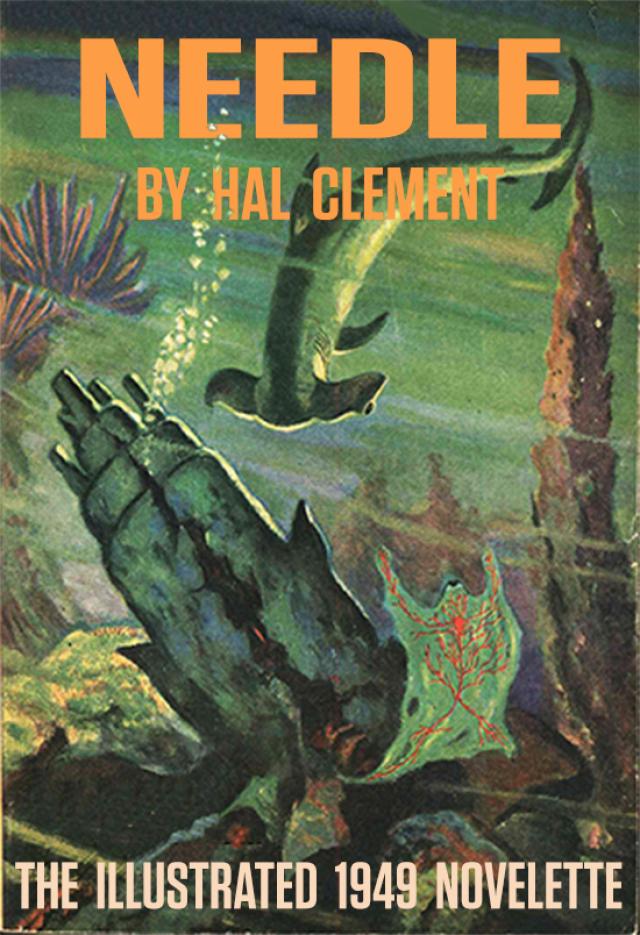
(book cover)
Jerry eBooks
Title Page
Copyright
FIRST OF TWO PARTS
CONCLUSION
Original Magazine Covers
FIRST
OF
TWO PARTS
Part 1
The Hunter suddenly realized that the ship ahead of him had become visible without the aid of instruments, and the vague alarm that had been nibbling at the outskirts of his mind rocketed into the foreground. He had been unable to understand why the fugitive should go below the speed of light at all, except in the hope that the pursuer would overrun him sufficiently to be beyond detection range; and when that failed, the Hunter had fully expected a renewed burst of speed.
Instead, the other ship had continued to decelerate. It had kept dead between the Hunter’s machine and one of the planets of the system through which they were passing, so it was dangerous to overhaul it too rapidly; the Hunter had thought that preparation was being made for a break back to the Allane or Tordel systems; and he had not realized how close they both were to the looming planet until the appearance of the fugitive’s hull as a spark of red against the blackness of the great world below showed he had actually entered its atmosphere.
That was enough for the Hunter. He flung every erg his converters could produce into a drive straight away from the planet, at the same time pouring the rest of his mass into the control room as a gelatinous cushion to protect his perit from the savage deceleration; and saw instantly that it would not be sufficient. He had just time to wonder that the creature ahead of him should be willing to risk its ship and host in what would certainly be a nasty crash, before the outer fringes of the world’s gaseous envelope added their resistance to his flight and set his outer hull glowing a brilliant orange.
The ships had dived straight down the shadow cone; they were plunging to the night side. With an effort, the Hunter kept an eye on the instruments that revealed the other vessel’s whereabouts; and it was well he did so, for the glowing cylinder abruptly vanished from sight into an enormous mass of water vapor that veiled the dark surface below them. A split second later, the Hunter’s ship plunged into the same mass; and as it did so there was a twisting lurch, and the right-line deceleration changed to a sickening spinning motion. The pilot knew that one of the drive plates had gone, probably cracked off by undistributed heat; but there was simply no time to do a thing about it. The other vessel, he noted, had stopped as though running into a brick wall; now it was settling again slowly; and he himself could be only split seconds from the same obstacle, assuming it was horizontal.
It was. The Hunter’s ship, still spinning wildly, though he had shut off the drive plate at the last moment, struck almost flat on water, and at the impact split from end to end along both sides, as though it has been an eggshell stepped on by a giant. Almost all its kinetic energy was absorbed in that blow; but it did not stop altogether. It continued to settle, comparatively gently now, and the half-conscious Hunter felt it bring its shattered hull to a gentle rest on what he realized must be the bottom of a body of water, a few seconds later.
At least, he told himself as his wits began slowly to clear, his quarry must be in the same predicament. The abrupt stoppage and subsequent slow descent of the other machine was now explained—even if it struck head on instead of horizontally, there would have been no perceptible difference in the result.
It was almost certainly unusable, even though not quite so badly damaged as the Hunter’s.
That idea brought the train of thought back to his own predicament. He felt cautiously around him, and found he was no longer entirely in the control room—in fact, there was no longer room for all of him inside it. What had been a cylindrical chamber some twenty inches in diameter and two feet in length was now simply the space between two-badly dented sheets of inch-thick metal, which had been the hull. The seams had parted on either side—or rather, seams had been made and forced apart; the hull was originally a single piece of metal worked into tubular shape—and the top and bottom thus formed had been flattened out and were now scarcely more than an inch apart, on the average. The buikbeads at either end of the room had crumpled like tissue. The pent was very dead—not only crushed by the collapsing walls, but the hydrostatic shock transmitted through the Hunter’s semifluid body, in which it has been suspended for protection, had ruptured most of its more delicate organs. The Hunter, realizing this slowly, withdrew from around and within the little creature. He did not attempt to eject its mangled remains from the ship; it might be necessary to use it as food later on, though the idea was unpleasant. The Hunter’s attitude toward the little animal resembled that of a man toward his dog.
He extended his explorations a little, reaching out with slender pseudopod through the rents in the hull. He already knew that the wreck was lying in salt water, but he had no idea of the depth other than that it was not excessive. On his home planet, he could have judged it quite accurately from the pressure; but he had not obtained a reading of this world’s surface gravity before the crash.
It was dark outside the hull. When he constructed an eye from his own tissues—those of the perit had been ruptured—it told him absolutely nothing of his surroundings. Suddenly, however, he realized that the pressure around him was not constant; it was increasing and decreasing by rather marked increments, with something like regularity; and the water was transmitting to his sensitive flesh those other pressure waves which he interpreted as sound. Listening intently, he finally decided he must be fairly close to the surface of a body of water large enough to develop waves a good-many feet in height, and that a storm of considerable violence was in progress. That he had failed to notice any storm during His catastrophic descent meant nothing whatever.
Poking into the mud around the wreck with other pseudopods, he found to his relief that the planet was not lifeless—he was already pretty sure of that fact, since there was enough oxygen dissolved in the water to satisfy his needs, provided he did not exert himself greatly; there must consequently be free oxygen in the atmosphere above. It was just as well, however, to have confirmation; and he was well satisfied to locate in the mud a number of small, bivalve mollusks which upon trial proved quite edible.
Realizing that it was night on this part of the planet, he decided to postpone further outside investigation until there was more light, and turned his ‘attention to the remains of his ship. He had not expected to find anything encouraging as a result of the examination, but he got a certain glum feeling of accomplishment as he realized the completeness of the destruction. Solid metal parts in the engine room had changed shape under the forces to which they had been subjected. The nearly solid conversion chamber of the main drive unit was flattened and twisted. There was no trace remaining of certain quartz-shelled gas tubes; they had evidently been pulverized and washed away by the water. No living creature handicapped by a definite shape and solid parts could have come through the crash alive, no matter how well protected. That thought was some comfort to him; he had done his best for the perk even though that had not been sufficient.
With these facts determined, the Hunter felt that he had done all that was possible for the time being.
No really active work could be undertaken until he reached open air; and the lack of light was also a severe handicap. He relaxed, therefore, within the questionable shelter of the ruined hull, and waited for the storm to end and the day to come. With light and calm water, he felt that he could probably reach shore without assistance; the wave noise suggested breakers, which implied a beach at no great distance.
He lay there for several hours. The darkness remained unbroken, and it occurred to him once that he might be on a planet whose rotation matched its revolution; but the presence of liquid water made that most unlikely, as he quickly realized.’ It was probable, that storm clouds were shutting out the daylight.
Ever since the ship had first settled into the mud, it had remained motionless. The terrific disturbance overhead was reflected in currents and backwashes, along the bottom which the Hunter could feel, but which were quite unable to shift the half-buried mass of metal. With this conclusion reached long since, the castaway was suddenly startled when his shelter quivered as though to a heavy blow, and changed position slightly.
Instantly he sent out an inquiring tentacle. He formed an eye at its tip, but the darkness was still intense, and he returned to a strictly tactile exploration. Vibrations suggestive of a very rough skin scraping along the hull were coming to him; and abruptly something living ran into the extended limb. It demonstrated its sentient quality by promptly seizing the appendage in a mouth that seemed amazingly well furnished with saw-edged teeth.
The Hunter allowed the portion of himself in direct contact with those unpleasant edges to relax into a semiliquid condition; and at the same time he sent more of his body flowing into the arm toward the strange creature. He was a
The shark—it was an eight-foot hammerhead—may have been surprised, but in common with all its tribe it lacked the brains to be afraid. Its ugly jaws snapped hungrily at what had at first been satisfyingly solid flesh, only to feel it give way before them like so much water. The Hunter made no attempt to avoid the teeth, since he was immune to mechanical damage of that nature, but he strenuously resisted the efforts of the fish to swallow that portion of his mass already within its mouth; he had no intention of exposing his flesh to gastric juices.
As the shark’s activities grew more and more frantically vicious, he sent exploratory pseudopods over the ugly, rough-skinned form, and within a few moments discovered the five gill slits on each side of the creature’s neck. That was enough. His actions were no longer directed by a spirit of inquiry; he knew, with a precision born of long experience, what to do.
He was a metazoan—a many-celled creature—in spite of his apparent lack of structure, but the individual cells of his body were far smaller than those of most life forms: they compared in size with the larger protein molecules. Consequently, he could put forth and control a pseudopod fine enough to enter the very capillaries of a more orthodox organism without interfering seriously with its blood circulation. He had, therefore, no difficulty in insinuating himself into the shark’s relatively huge body.
He avoided nerves and blood vessels as much as possible, and poured himself into such muscular and visceral interstices as he could locate. The shark calmed down at once, after the thing in its mouth and on its body ceased causing tactile messages to reach its minute brain; its memory was to all intents and purposes nonexistent. For the Hunter, however, successful interstition was only the beginning of a period of intense activity.
First and most important, oxygen. There was enough of the precious element absorbed on the surfaces of his body cells for only a few minutes of life at most. But it could always be obtained; in the body of a creature that also consumed oxygen; and the Hunter rapidly sent submicroscopic appendages between the cells that formed the walls of blood vessels, and began robbing the oxygen-bearing cells of their precious load. He needed but little, and on his home world he had lived for years within the body of an intelligent oxygen-breather, as did most of his kind, with the other’s full knowledge and consent. He had more than paid for his keep.
The second need was vision. His host presumably possessed eyes; and with his oxygen supply assured the Hunter began to search for them. He could, of course, have sent enough of his own material through the shark’s skin to construct an organ of vision, but he might not be able to avoid disturbing the creature by such an act. Ready-made lenses were to be preferred; so he began seeking them.
He was interrupted very quickly. The crash had taken place, as he had deduced, rather close to land; the encounter with the shark had occurred in relatively shallow water, and had taken only a’ short time. Sharks are not fond of disturbance; it is hard to understand why this one had been so close to the surf. During the monster’s struggle with the Hunter, it had drifted or been carried still closer to the beach; and with its attention no longer taken up by the intruder, it turned all its energies toward getting into deep water. This the Hunter did not know, having no sensory contact with the outer world. But once the shark began to exert itself, after the Hunter’s establishment of an oxygen-theft system, things, began to happen. The breathing system of a fish operates under a disadvantage, since the oxygen in the water is never at a very high concentration; and a water-breathing creature never has much oxygen to spare. Little as the Hunter was taking, it was enough to cut down the shark’s physical powers markedly; at the same time, its blood-oxygen content decreased, and the Hunter almost unconsciously increased his drain on the system. It was a vicious circle that could have but one ending.
The Hunter realized what was happening before the shark actually died, but he could not cut down his own use of the precious gas any further. He could have left the shark, of course, but that would have left him almost completely helpless and adrift in the sea. Also, he had long since realized perfectly the shark’s position on the evolutionary scale, and felt no particular compunction in sacrificing a savage carnivore to his own needs. The fact that the creature’s efforts were probably being made against the waves, and that these were almost certainly carrying him where he wanted most to go, influenced his decision.
The shark took a long time actually to die, though it became helpless very quickly. Once it had ceased to struggle, the Hunter continued the search for its eyes, and eventually found them. He deposited a film of himself around and between their retinal cells, in anticipation of the time when there would be enough light for him to see by, and then let nature take its course.
The breakers were sounding much more loudly by this time, and he realized that the assumption that he was drifting shoreward had been justified. The shark was drifting toward the surface as well, and a sickening up-and-down motion became perceptible as it entered the sphere of influence of the waves. Once or twice it actually broke the surface, and the Hunter, who had oxygen-seeking appendages already extended from the great fish’s gill openings, profited thereby.
The rolling, tossing, and pounding suffered by the shark when its body finally entered the breakers was of such a nature that the Hunter was a little surprised at the small amount of resultant damage. Even he did not fully appreciate the enormous toughness of that semi-vertebrate structure. At last, after many minutes of forward-and-back motion in the shallows, they grounded; and though the backwash of the waves strove to drag the great body back to the sea, it was never quite successful. After a long time, the number of waves breaking over them began gradually to decrease, and the Hunter suspected that the storm was diminishing in intensity. In actuality, the tide had turned; but the result was the same.
By the time the combination of approaching dawn and thinning storm clouds provided enough light for the Hunter to see a little of his surroundings, his late host was thoroughly stranded, several yards above the reach of the heaviest waves, and well entangled in a mass of seaweed. The shark’s eyes refused to focus on their own retinas out of the water, but the Hunter found a focal surface within the eyeball and built a retina of his own on it. He was also forced to modify certain imperfections in the lenses with more of his own body substance; but at last he was able to see about him with satisfactory clarity, yet without exposing himself.
There were rifts in the storm clouds now, through which a few of the brighter stars were visible against the gray background of approaching. dawn. Slowly these breaks grew larger, and by the time the sun appeared above the horizon the sky was almost clear, though the wind still blew fiercely.
His vantage point was not ideal, but he was able to make out a good deal of his surroundings. In one direction the beach extended a short distance to a line of tall, slender trees, crowned by feathery tufts of leaves. He could not see beyond these, his vantage point being too low, though they were not themselves thickly enough set to obstruct the view. In the opposite direction was more debris-strewn beach, with the roar of the surf sounding beyond it. The Hunter could not actually see the ocean, but its direction was obvious. To the right as one looked at the trees was a body of water; and for a moment the Hunter was a trifle surprised, for it showed no sign of the huge waves that were still pounding behind him. Then he realized it must be a small pool, filled by the storm, but now emptying back into the sea so that the large waves could not enter. This, he realized, was probably the reason he had stranded so easily; his shark had been washed into this pool, and left behind by its diminishing waters.
Several times he heard raucous screeching sounds and saw birds overhead. This pleased him greatly; evidently there were higher forms of life than fishes on the planet, and there was some hope of obtaining a more suitable host. An intelligent one would be best, since it would ordinarily be best able to protect itself and him and was also likely to travel more widely, thus facilitating the now necessary search for the pilot of the other ship; but he realized that there might be some difficulty in obtaining access to the body of an intelligent being who was not accustomed to the idea of symbiosis.