Hermann goring, p.1
Hermann Göring, page 1


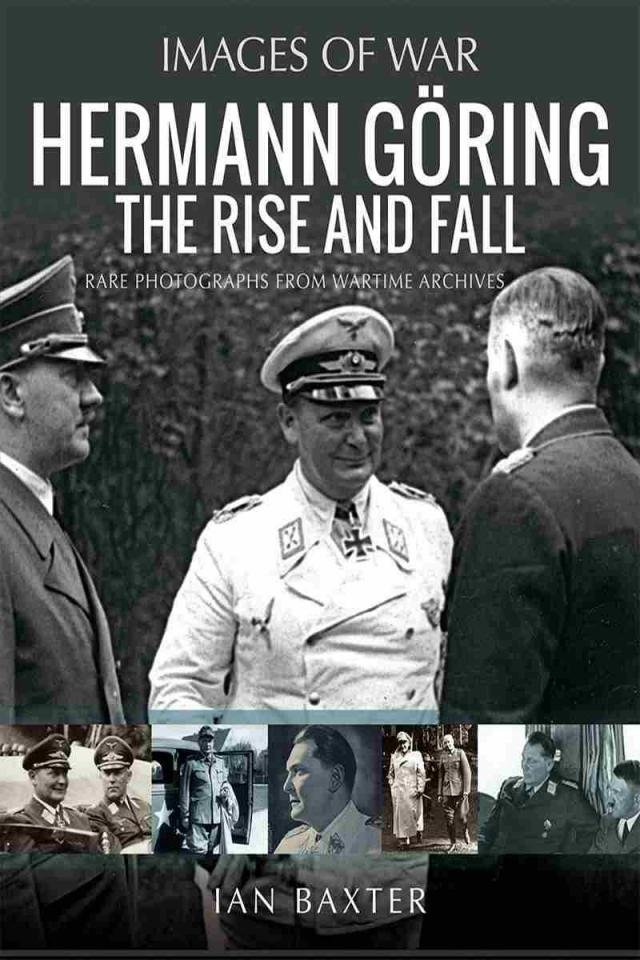
IMAGES OF WAR
HERMANN GÖRING: THE RISE AND FALL
RARE PHOTOGRAPHS FROM WARTIME ARCHIVES
Ian Baxter
First published in Great Britain in 2024 by
PEN & SWORD MILITARY
an imprint of Pen & Sword Books Ltd
Yorkshire – Philadelphia
Copyright © Ian Baxter, 2024
ISBN 978-1-39905-043-2
ePub ISBN 978-1-39905-044-9
Mobi ISBN 978-1-39905-044-9
The right of Ian Baxter to be identified as the author of this work has been asserted by him in accordance with the Copyright, Designs and Patents Act 1988.
A CIP catalogue record for this book is available from the British Library.
All rights reserved. No part of this book may be reproduced or transmitted in any form or by any means, electronic or mechanical including photocopying, recording or by any information storage and retrieval system, without permission from the Publisher in writing.
Pen & Sword Books Limited incorporates the imprints of After the Battle, Atlas, Archaeology, Aviation, Discovery, Family History, Fiction, History, Maritime, Military, Military Classics, Politics, Select, Transport, True Crime, Air World, Frontline Publishing, Leo Cooper, Remember When, Seaforth Publishing, The Praetorian Press, Wharncliffe Local History, Wharncliffe Transport, Wharncliffe True Crime and White Owl.
For a complete list of Pen & Sword titles please contact PEN & SWORD BOOKS LTD
47 Church Street, Barnsley, South Yorkshire, S70 2AS, England
E-mail: enquiries@pen-and-sword.co.uk
Website: www.pen-and-sword.co.uk
or
PEN & SWORD BOOKS
1950 Lawrence Rd, Havertown, PA 19083, USA
E-mail: uspen-and-sword@casematepublishers.com
Website: www.penandswordbooks.com
Contents
Introduction
Chapter One
Early Years, 1914–38
Chapter Two
The Year of Triumph, 1939–40
Chapter Three
Eastern Front, 1941–42
Chapter Four
Decline, 1943–45
Chapter Five
Retribution
Epilogue
About the Author
I an Baxter is a military historian who specialises in German twentieth-century military history. He has written more than fifty books including Poland – The Eighteen Day Victory March, Panzers in North Africa, The Ardennes Offensive, The Western Campaign, The 12th SS Panzer-Division Hitlerjugend, The Waffen-SS on the Western Front, The Waffen-SS on the Eastern Front, The Red Army at Stalingrad, Elite German Forces of World War II, Armoured Warfare, German Tanks of War, Blitzkrieg, Panzer-Divisions at War 1939–1945, Hitler’s Panzers, German Armoured Vehicles of World War Two, Last Two Years of the Waffen-SS at War, German Soldier Uniforms and Insignia, German Guns of the Third Reich, Defeat to Retreat: The Last Years of the German Army at War 1943–45, Operation Bagration – the Destruction of Army Group Centre, German Guns of the Third Reich, Rommel and the Afrika Korps, U-Boat War, and most recently, The Sixth Army and the Road to Stalingrad. He has written over a hundred articles including ‘Last days of Hitler’, ‘Wolf’s Lair’, ‘The Story of the V1 and V2 Rocket Programme’, ‘Secret Aircraft of World War Two’, ‘Rommel at Tobruk’, ‘Hitler’s War with his Generals’, ‘Secret British Plans to Assassinate Hitler’, ‘The SS at Arnhem’, ‘Hitler-jugend’, ‘Battle of Caen 1944’, ‘Gebirgsjäger at War’, ‘Panzer Crews’, ‘Hitlerjugend Guerrillas’, ‘Last Battles in the East’, ‘The Battle of Berlin’, and many more. He has also reviewed numerous military studies for publication, supplied thousands of photographs and important documents to various publishers and film production companies worldwide, and lectures to various schools, colleges and universities throughout the United Kingdom and Southern Ireland.
Introduction
A veteran First World War fighter pilot ace, Hermann Göring went on to become the second most powerful man in Nazi Germany. He was known for being one of the primary architects of the Third Reich state police, establishing the Gestapo and concentration camps for the ‘corrective treatment’ of difficult opponents. Ambitious and merciless, he took many positions of power and leadership within the Nazi state, becoming Commander-in-Chief of the Luftwaffe (German Air Force) and Director of the Four-Year Plan in the German economy. He established the Central Office for Jewish Emigration, and the Final Solution to the Jewish Question, and as war broke out across Europe in 1939, he was acknowledged as Hitler’s successor. The following year, he was given the special rank of Marshal of the Empire, which made him senior to all field marshals in the military, including the Luftwaffe.
As the war dragged on and the Germans were beset by a number of military disasters for which Göring was directly blamed, his popularity with Hitler and his inner circle declined. By the end of the war, the flamboyant and delusional Göring was expelled from the party for ‘illegally attempting to seize control of the state’.
Following Hitler’s suicide, Göring was captured, and stood trial for his crimes at Nuremberg. He was found guilty, primarily for being the leading war aggressor, both as political and as military leader of Germany. He was blamed for being the director of the slave labour programme and the creator of the oppressive plan against the Jews and other races. However, he avoided the hangman’s noose by committing suicide in his cell.
This volume of the Images of War series brings the wartime career of this ruthless and proficient man into sharp focus, and is supported by powerful images.
Chapter One
Early Years 1914–38
Hermann Göring was born on 12 January 1893 at the Marienbad Sanatorium in Rosenheim, Bavaria. From a very young age, he developed an interest in the military and was often seen playing with toy soldiers and dressing up in a Boer uniform that his father had given him. By the time he went to boarding school at 11 years of age, the prospect of becoming a soldier was deeply ingrained and he continued to enjoy war games, pretending to lay siege to Veldenstein Castle and studying Teutonic legends and sagas. During his early teenage years, he thrived in his surroundings, living in the midst of tall pine trees, valleys, deep ravines and mountain slopes. Often he would escape from adult supervision and explore in the forest. This idyllic lifestyle suited the young Göring. In spite of having three older sisters and a younger brother, he would venture out without them to fulfil his fascination with the landscape. He soon became a mountain climber, scaling peaks in Germany and the Alps, including the Mont Blanc Massif, which straddles Italy, France and Switzerland.
This was a strongly formative phase in Hermann’s character development and as he grew through his teens, he continued to romanticise about a life in the military. For him, the thought of being a soldier was firmly rooted as the Göring family had a military background, with his father, Heinrich, being a former cavalry officer. At the age of 16, Hermann enrolled in the military academy at Berlin Lichterfelde, from which he graduated with distinction. Determined to fulfil a lifelong military career, dutiful and proud he joined the Prince Wilhelm Regiment of the Prussian Army in 1912. While he was serving in the army, his family moved to Munich, the Bavarian capital city, which sparked his patriotism for his beloved Germany.
When the war began in August 1914, Göring was stationed with his infantry regiment at Mulhausen, a garrison town very close to the French border. During his wartime service there, his comrades regarded him as a committed, dutiful young soldier who did not lack physical courage on the battlefield. However, due to the terrible living conditions and the dampness of trench warfare, he was hospitalised with rheumatism. While recovering from his illness, his friend Bruno Loerzer persuaded him to join the air combat forces of the German Army, which were by 1916 known as the Luftstreitkräfte. Although his request was rejected, he later that year informally flew as Loerzer’s observer in the Feldflieger Abteilung 25 (FFA 25). When this was discovered, Göring was sentenced to three weeks’ confinement to barracks, but this was soon overturned and he and Loerzer were formally assigned as a team to the FFA 25 in the Crown Prince’s Fifth Army. They subsequently undertook a series of reconnaissance and bombing missions, for which the Crown Prince decorated them each with the Iron Cross, first class.
Göring then began a pilot training course and after completion was assigned to Jagdstaffel 5. As a pilot, his relations with his immediate comrades were good and he thoroughly enjoyed the camaraderie. In fact, it seems that during his flight training, the majority of his colleagues respected him, liking his friendly, outgoing and affable manner, when he always joined in the good-natured conviviality, sometimes at his own expense. However, there was another side to his personality that could be very serious, with some of his comrades observing that he would discuss various topics that often included Germany being victorious. When he was not conversing, he was regularly seen sitting for hours in a corner of a room, reading.
As a pilot, Göring was skilful and daring, but not long after completing his flying training, he was seriously wounded in the hip during an aerial combat. The injury was so bad that it took him nearly a year to recover. In early 1917, he returned to flying and was transferred to Jagdstaffel 26. His exemplary record in the skies soon earned him an assignment to command Jagdstaffel 27. Serving with Jastas 5, 26 and 27, he steadily scored many air victories and for his service, he was awarded the Iron Cross 1st and 2nd class, the Zähringer Lion with swords, the Friedrich Order, and the House Order of Hohenzollern wi
The following year, in May 1918, Göring was bestowed another decoration for his merits, the Pour le Mérite. He finished the war having notched up between seventeen and twenty-two victories. On 7 July 1918, following the death of Wilhelm Reinhard, successor to Manfred von Richthofen, Göring became commander of the ‘Flying Circus’, Jagdgeschwader 1. His leadership was brief, and by November 1918, Germany had surrendered and the war was lost.
Göring’s experiences during the conflict had clearly affected him. When he returned to Munich penniless, like many veterans, he thought of nothing else but the humiliation of losing the war and the human suffering he had witnessed. In spite his pessimism he remained in aviation and briefly worked at Fokker. Then, in 1919, he packed up his belongings and decided to leave his homeland for Denmark. He soon moved on to Sweden and joined the Swedish airline Svensk Lufttrafik. From 1920 to 1921, Count Eric von Rosen hired Göring to fly him to his castle in Stockholm. It was here at Rockelstad Castle that Göring met a young girl who was Count von Rosen’s sister-in-law, Baroness Carin von Kantzow. It was not long before he fell in love with her, and on 3 February 1923, they married. Their first home was a hunting lodge at Hochkreuth in the Bavarian Alps, approximately 50 miles from Munich.
Although financially, Göring’s situation had changed for the better following his marriage to the baroness, a climate of political and ideological radicalisation was spreading through Munich and indeed across the whole of Germany. Many of his veteran friends shared with him the shame of surrender and distrust of a Germany they considered was degenerating into Bolshevism. They were witnessing the collapse of the society they had once known and many of Göring’s former colleagues often found civilian life difficult and oppressive. In defeat, aggressive nationalism had spread through many German towns and cities, and quickly created various political movements and shifting allegiances. During this period, Germany was plunged further into a maelstrom of civil unrest, which had produced a string of politically extreme right-wing parties. One of these was the National Socialist German Workers’ Party, or Nazi Party. Scores of veteran fighters from the Great War soon became Nazi sympathisers. Many had grouped into bands of idealistic activists who had shared the Nazi vision to defend Germany from the destructive embrace of Bolshevism. Understandably, these veterans, including Göring, responded with enthusiasm to various announcements made by the Nazi Party condemning the Spartacist menace and calling every able veteran to join the Nazis and support the mutiny. Göring soon attended one of the Nazi rallies and met Adolf Hitler, an old veteran fighter like himself. He then joined what he considered was the new brotherhood of the frontline fighters, the Nazi Party, in November 1922. For Göring, joining the Nazi Party evoked a kind of rebellion.
Although the Nazis were undoubtedly anti-Semitic and saturated the movement with negative stereotypes of Jews, Göring initially looked upon them as of secondary consideration to the party. He was more interested in removing the national shame, reversing the humiliation of the Treaty of Versailles, combating the threat of communism and curbing the socialists rather than fighting a religious minority. In his own mind, like Hitler, he painted himself as a martyr for the cause. Here in the Nazi Party, his new life was full. He was mixing with a wide array of colourful characters who all had something in common – a desire to restore Germany back to its rightful position and to address the fear of Marxism. Speaking into the long hours of the night, both he and his leader, Adolf Hitler, became romantic revolutionaries, revelling in the company of other party members. They all looked upon Hitler with unequivocal admiration and were driven on by his plans of crushing Bolshevism and resisting French occupation in the Ruhr, which he said were winning applause from most patriotic nationalists throughout Germany. Captivated by the Nazi Party ethos, Göring and his wife Carin regularly played host to the meetings of leading Nazis.
Göring had clearly shown his worth to Hitler. Being ardently nationalistic, anti-Marxist, an anti-parliamentarian and dedicated to a new order, his leader gave him command of the Sturmabteilung (SA), or Storm Troopers, in 1923. During this period of civil unrest and high unemployment, Hitler and the Nazi Party continued to hold mass meetings and rallies in Munich in order to plan to overthrow the Bavarian government in the city. From 8 to 9 November 1923, the Nazis attempted to seize power in a failed coup that became known as the Beer Hall Putsch, when twenty of their number, including Göring, marched through the streets of Munich to the War Ministry. The march soon turned into a bloodbath, and fourteen Nazis and four policemen were killed. Having received a bullet in the groin, Göring was smuggled to a hospital in Innsbruck, where he underwent surgery and was given morphine for the pain.
Hitler was thrown into prison for the attempted coup, whilst Göring convalesced and assisted his FÐührer in rebuilding the Nazi Party. As he spent time recuperating, he read a variety of material that strengthened his resolve and bolstered his beliefs. It was through literature that he became interested in heredity and racial research, and in particular, Hitler’s new book, Mein Kampf. He also read the works of Josef Goebbels, and Alfred Rosenberg’s The Myth of the Twentieth Century. Slowly, it gave him a deeper insight into Nazism, with all its rules of race, social efficiency and ideological conformity. He revelled in the Nazi theory of the laws of nature, the Darwinist doctrine of survival of the fittest, and that the weak should go to the wall. He read further about the struggle between nations and between races, and learnt that the German nation as a whole was engaged in a crucial struggle between Aryans and Jews, and this would decide the fate of humanity. Magazines like Der Stürmer also helped him, like other extreme National Socialists, mould an obsessive hatred and fear of Jews. Increasingly, he took mounting interest in the future development of the Nazi Party and its violent opposition towards the Jews. His fascination with the military, too, and his pronounced German nationalism made him the sort of individual who was, during that time, receptive to racial ideology. Like so many Germans of that period, he had always been suspicious of Jews, but he was still capable of distinguishing between those he liked and disliked. Gradually, while helping to rebuild the party, his own emotional and intellectual pursuits drove him to read more material that presented Jews as conspirators against Germany. As time went by, he became increasingly fixated on the Jews as the ‘enemy’. Little by little, he formulated his reasons for why the Great War had been lost and eventually, even he began to believe that it was perhaps down to an international Jewish conspiracy.
By the mid-1920s, the German economy was showing signs of a slow recovery, which meant fewer opportunities for the Nazis to seize and take advantage. The SA was reorganised and Franz Pfeffer von Salomon became head of the movement, replacing Göring, who was destined for higher promotion within the ranks of the party. In May 1928, the Nazis obtained twelve seats in the Reichstag and Göring was elected as a representative from Bavaria. Now holding a more prominent seat in government, he had secured a higher role in the Nazi movement. Four years on, in the July 1932 elections he was selected as President of the Reichstag after the Nazis won 230 seats. Months later, during the night of 27 February 1933, following Hitler’s succession to power, the Reichstag was set on fire. At the Nuremburg trials in 1946, General Franz Halder testified that Göring admitted he started the fire in order to blame it on the German Communist Party.
Göring’s political influence in the Nazi Party was now secured. When Hitler became Chancellor of Germany, Göring was appointed as Reichsminister without portfolio and Reichskommissar of Aviation. He was then appointed as Minister President of Prussia, Prussian interior minister and chief of the Prussian police. On 26 April 1933, Göring established a special Prussian police force. The force was called the Geheime Staatspolizei (Secret State Police), the Gestapo. Around the same time of creating the new police force, his Führer also gave him powers as Reichsstatthalter (Reich Governor). Later that year, in October 1933, he became a member of the Academy for German Law, which had been founded in June that year by Hans Frank. In July 1934, Göring was appointed Reichsforstmeister, with the rank of Reichsminister.