

Wand, p.1
Wand, page 1


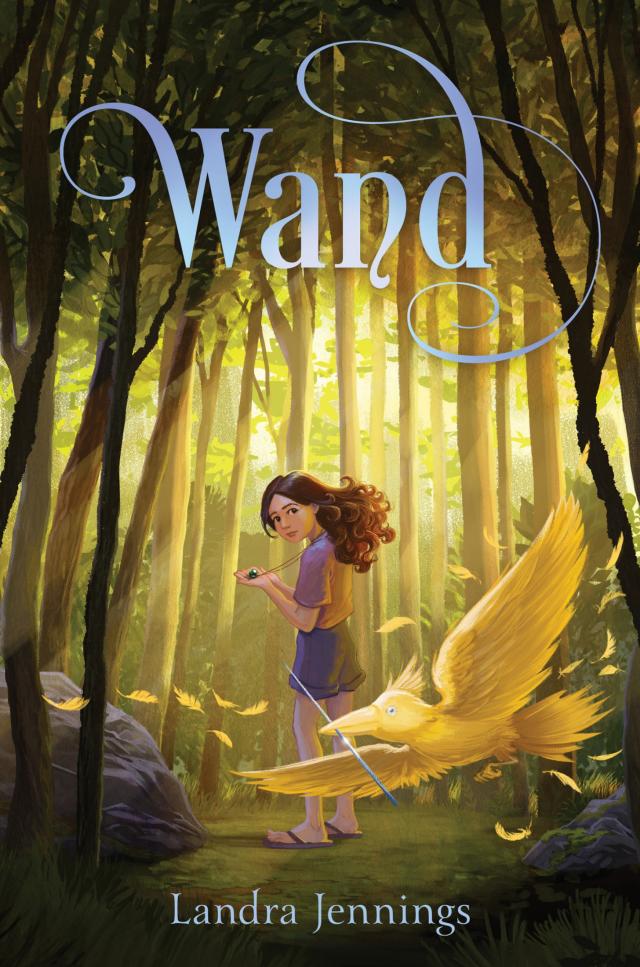
Dedication
For John, Thomas, and Will
Contents
Cover
Title Page
Dedication
Chapter One
Chapter Two
Chapter Three
Chapter Four
Chapter Five
Chapter Six
Chapter Seven
Chapter Eight
Chapter Nine
Chapter Ten
Chapter Eleven
Chapter Twelve
Chapter Thirteen
Chapter Fourteen
Chapter Fifteen
Chapter Sixteen
Chapter Seventeen
Chapter Eighteen
Chapter Nineteen
Chapter Twenty
Chapter Twenty-One
Chapter Twenty-Two
Chapter Twenty-Three
Chapter Twenty-Four
Chapter Twenty-Five
Chapter Twenty-Six
Chapter Twenty-Seven
Chapter Twenty-Eight
Chapter Twenty-Nine
Chapter Thirty
Acknowledgments
About the Author
Copyright
About the Publisher
Chapter One
Something watched from the kitchen window.
Mira noticed it peering in as she gathered the ingredients for the pancakes.
The others didn’t seem to notice. Ten-year-old Sara waltzed around in her pajamas and a pair of yellow sunglasses missing the lenses. Sara’s four-year-old little sister, Beans, sat kicking the table, fully decked out in green knee socks and the pink princess dress she’d been wearing for a week. Val was on the phone, leafing through mail and doing a lot of sighing.
It was a bird with golden feathers and a pointed bill, perched in the mulberry tree outside. Mira felt its stare whenever she passed the window. She’d never seen a bird like that before.
Val put a hand over the phone. “Thanks so much for cooking again, Mira.”
Mira gave a little jump and nodded. It was impressive, she knew, being in charge of the pancakes when she was only eleven.
Val didn’t say anything more to Mira; she went back to her conversation, holding the phone between her chin and shoulder while she pulled her long blond hair into its typical ponytail. She wore her Shampooch Palace T-shirt. She’d be leaving for work soon.
“I want honey on mine,” Beans said, adjusting the headband of silver stars that was nestled in her curls. “Pixies love you if you smell like honey.”
Mira blinked, forgetting about the bird for a moment. “There’s no such thing as pixies. And you love chocolate chips, remember? Chocolate chips are our special Saturday morning tradition.”
“Our charming tradition,” Sara interjected chirpily. Her cheerfulness had a forced note, as it often did. She wielded an imaginary sword, miming a poke at Val, who waved her away.
“Tradition is dumb.” Beans’s r’s often sounded like w’s, especially if she was upset. Twadition.
“Would you like to help me with the pancakes?” Mira said.
Beans came alert and hopped down to shove her chair over to the counter; the chair legs scraped loudly against the floor tile.
A flash of gold in the window. The rushing of wings. The bird, leaving. Maybe the noise had startled it. Mira felt an unexplainable relief.
She steadied the chair while Beans climbed up to stand on the seat. Beans was such a small girl, with short, delicate limbs, like her mom and sister. She insisted she didn’t need any help now that she was four, but she weighed almost nothing. If she fell, Mira could easily catch her.
Beans took an egg in her small fingers, cracked it against the side of the bowl, then proceeded to dump the yolk, the whites, and most of the shell inside.
Mira wanted to roll her eyes, but Beans would have noticed. “Excellent work,” Mira said, and fished out the shell bits with a spoon. She guided Beans in using the nonstick spray can. Beans coated the griddle as well as a generous portion of the wall behind the stove.
Mira sponged off the wall, glanced at Val to see if she was admiring how helpful Mira was being (Val wasn’t), then poured dollops of batter onto the griddle. She showed Beans how to wait for the tops to bubble, how to use the turner. The scent of melting chocolate filled the air.
Val went into the family room next to the kitchen and began whispering into the phone.
What was it about whispering that caused you to listen harder? Mira caught a few words like expensive and extra hours, and her stomach twisted. Val had taken Mira to It’s Fashion last week because she was outgrowing all of her clothes. Mira’s heart had dropped at the total on the register, and she didn’t mention she needed new shoes too—the only shoes that still fit her were flip-flops. Was Val talking about how much the clothes had cost?
Mira and Beans finished making the pancakes, and Val appeared in the kitchen doorway. “Can you watch the girls tomorrow afternoon, Mira? At the library? I’m going to help Abbie.” Abbie owned a cleaning service. If she had an apartment move-in or move-out on a day when Shampooch Palace was closed, she often asked Val for help.
Again? Mira thought. But she turned her lips up into a quick smile and nodded before nibbling at her breakfast. She focused on the warmth of the pancake on her tongue, along with the sweetness of the syrup, trying to bring back that special Saturday-morning feeling she used to get when Papa was still here. Then she put the dishes in the dishwasher and walked on her toes—a habit left over from gymnastics—into the family room, where Val was rummaging in her purse.
Mira ran her fingers over the smooth leather of the recliner that’d once been Papa’s. No one really wanted that chair anymore. These days they mostly used it to hold laundry. It was just an extra thing no one knew what to do with, that chair. A random old thing that was just still here.
Like me, Mira thought. A lump formed in her throat, and she reached for the pendant on her necklace. The opaque emerald-green stone reminded Mira of a fig beetle and always felt warm. But sometimes even the warmth of the pendant didn’t provide comfort. A wave of sadness washed over her.
Val was jamming her feet into her work shoes without untying the laces; she glanced up. “Everything okay?”
No, Mira thought. But she reminded herself of what Val had done, the horrible thing she had done on that terrible day, and why Mira could never ever forgive her. A familiar heat flooded Mira’s chest. It dried up all the sadness. She cleared her throat. “Yes, everything’s fine.”
The doorbell rang and Val hurried to answer.
Some instinct made Mira glance out the window that faced the back porch. Even at that distance, she could see the bird in the magnolia tree. It hadn’t flown off; it’d only moved from the front yard to the back, its golden presence unmistakable. Though she would have thought it difficult to see her from that far away, and through a sheer curtain no less, it did seem to be watching. Not foraging, not building a nest, just watching.
That bird was too big, too bright, too strange. It didn’t fit in around here any better than Mira did. What was it doing here? Where had it come from?
Chapter Two
Glass Pond wasn’t any good for swimming. Mira knew that. Everyone in Between, Georgia, knew that.
And even if they hadn’t, they wouldn’t have been able to try it out for themselves. The pond behind the Marathon gas station was locked up tight, surrounded by a tall wooden fence someone had painted black and fronted by a collection of cypress and holly trees interwoven with vines. The gate wasn’t operable—or didn’t seem to be; there wasn’t a latch in view. No Admittance signs were plastered everywhere.
Of course, all that trying to keep people out just made some people want to get in. But the occasional hooligan reported the gate wouldn’t budge, the fence was full of sharp splinters, and the shrubbery was host to countless copperheads and yellow jackets just waiting to get ahold of whoever tried to penetrate the tangle.
Mrs. Martha, who worked at the Between Grocery attached to the gas station, was quick to warn anyone who would listen about the danger. She wasn’t sure who owned the property, she said, but whoever they were, they didn’t do enough caretaking. She whispered about some people who had drowned there, once upon a time, and laughed off the more outlandish rumors, rumors that were bound to circulate in a town where there wasn’t quite enough to occupy everyone’s time.
The rumors were of the ridiculous sort—even Papa had said so: how Glass Pond supposedly led to someplace else. How it vomited up the strange characters who appeared randomly, confused and disoriented, in the gas station parking lot. How the odd people clearly weren’t from around here and probably weren’t from anywhere on Earth. I mean, look at them! A man with a mustache on his forehead who sang for quarters. A woman in purple pantaloons who claimed a snake lived in her nose (no one had actually confirmed this). A bald individual who kept asking people to pick a card from a very peculiar deck. Those types of people surely must’ve gotten sucked through Glass Pond from elsewhere—otherwise why would they have ended up in the nowhere town of Between, of all places?
Mrs. Martha would cheekily claim that souls certainly came from all over to sample the chicken and biscuits she cooked up for to-go lunches at the Between Grocery. That she was out-of-this-world famous. And the townspeople would laugh and agree that the strange people must have come from far afield to sample her legendary fare, though the rumors were more fun to think about.
The babysitter, Mrs. Sutter, loved to talk about Glass Pond. In fact, Mrs. Sutter claimed to b e something of an expert in the doings of the pond. However, Mira, Sara, and Beans had already heard all of her theories because the woman came over a lot.
Up until a year ago, Mrs. Sutter had been merely the crabby old lady next door, the one Papa and Gammy hadn’t liked, the one with the white hair, bottle-thick glasses, and habit of going out with a baseball bat whenever unfamiliar cars drove by. But when Val decided to add more days to her weekly work schedule and eliminate Mira’s and Sara’s after-school activities, she’d gotten more desperate than ever for babysitters, and somehow Mrs. Sutter convinced Val she was perfect for the job.
That Saturday afternoon, Mrs. Sutter was at their house again, as usual. She was also making Mira miserable, as usual. That was because Mrs. Sutter’s second-favorite topic of discussion was Mira: she slouched too much, she frowned too often, she didn’t make enough of an effort to be pleasant.
Mrs. Sutter sat heavily on the sofa, fixing her gaze on Mira.
Mira sank deeper into Papa’s recliner, holding her book—Orphan Island—a little higher, hoping the woman would take the hint.
“Them that come out of Glass Pond are rude like you,” Mrs. Sutter said. “Them that’s magic think they know what’s what.”
The woman was going to get up and collect Mira’s book soon, Mira knew. You look your elders in the eye, young lady. Mira wondered why Mrs. Sutter didn’t prey on the others instead of her. She put her book down and tried to make her voice respectful. “I like to read. It’s good for you.” Papa had always said it.
“You think you’re so smart, don’t you?” Mrs. Sutter said. “Smarter than the others, at least in your own high-and-mighty mind. Probably think you’re going to college.” And her lips pursed into a tiny, satisfied smile, like she knew something Mira didn’t.
Mira hadn’t given any thought to college. She shrugged and studied the carpet, trying to figure out how to escape. She’d be upstairs in the attic if it wasn’t so stifling this time of day.
“Val ought to get a medal, putting up with you and your attitude,” Mrs. Sutter said.
Mira didn’t believe she had an attitude. But arguing with Mrs. Sutter accomplished nothing.
“You ought to be thankful Val keeps you here at all,” Mrs. Sutter said. “You’re no kin to her. I sure wouldn’t have you. Not a thankless girl like you. Let’s just hope your meager efforts are enough.”
Mira’s face was getting hot. She stood. “I’ve got to, um, go.” Unfortunately, Mrs. Sutter raised her voice and, even when Mira was in the bathroom, she could hear the woman talking about how Mira wasn’t nearly grateful enough for her many blessings.
Mira shoved a rolled towel into the crack at the bottom of the door and tried making herself comfortable on the bathmat with her book, but found her arms shook and the page was blurry and she couldn’t read a word.
When Mrs. Sutter first told Mira last year that Val only kept Mira around to be useful, Mira had wanted to ask Val about it, but for some reason hadn’t been able to get the question out of her lips.
Instead, Mira tested the theory. One Sunday, she’d washed Beans’s clothes in addition to her own, vacuumed the family room, and weeded the front walk. At the end of that day, Val was much happier. She smiled for the first time in a week, praised Mira for her good work, and started consulting her on the grocery list. It was important Mira earn her keep, she’d realized. She needed to be useful. Like it or not, that was her role in the house these days.
Mira put her book down, wiped her eyes, and took a deep breath. She retrieved the Comet cleanser and a scrub brush from beneath the sink and began a vigorous attack on the tub.
That night, Mira had a dream she’d been having frequently. She was on the balance beam, doing the big-arms toe-touch routine she’d done on the floor beam when she was first learning gymnastics. Only, the beam wasn’t on the floor. The beam seemed to be somewhere in space—there was just darkness below her, a swirling, fathomless depth. And she carried heavy suitcases in each hand as she carefully placed her feet, suitcases that were somehow terribly important, although she didn’t know what was in them. Her arms were straining, straining, trying to hold the suitcases up and out from her body. Sweat poured down her face.
She was going to lose her balance, she felt, at any minute. And then she would fall.
Chapter Three
When Mira was nine, a fledging crow had appeared one morning outside her bedroom window, abandoned on the sill. A day passed and the bird’s parents didn’t come to claim it. The young bird began to look feeble, staring in at her. She put out boiled eggs and cooked oatmeal like Papa suggested, and the crow soon perked up.
Bandit still lived in the woods nearby. Mira never knew when he would come around. Or what he would try to take when he did. He came by his name naturally.
One week, it was wiper blades. Mira would see him flying by, floppy blades hanging from his bill. She didn’t know which cars he raided. Another time, it was small metal objects like keys, screws, or toys. Beans had to move her Hot Wheels collection inside for safekeeping. Lately, Bandit was obsessed with anything that looked like a stick. It had gotten so bad, Mira couldn’t do her homework on the picnic table without him suddenly appearing from nowhere to make a great swoop for her pencil.
True, Bandit was a bit of a thief. But he also took it upon himself to warn Mira of dangerous things. Naturally, they were things the crow considered dangerous, not necessarily the things Mira did. It often took some time for her to locate the source of his distress: an owl roosting in a tree nearby; a dozen fake crows a neighbor had put out for Halloween decor; a particularly aggressive display of balloons, hung to celebrate someone’s graduation.
That Sunday morning it was the strange bird that Bandit was concerned about.
From a high branch in the magnolia tree, the bird’s golden feathers glowed in the morning light.
Mira was sitting on the flat rock beside the sandbox. “I see him, Bandit. It’s okay.”
Bandit, in the nearby maple tree, grumbled, but his ruffled feathers smoothed.
Mira had a way with animals. Papa had often commented on it. Not only Bandit, but the other birds, the rabbits, deer, and even the foxes, who would let their pups venture into her yard to have their fuzzy heads rubbed. She held out a hand for the strange bird. “Come on,” she said. “I wouldn’t hurt you.”
But the bird just turned his golden head this way and that, inspecting her from one eye and then the other, making no move to come closer.
Mira let her arm drop. “That’s all right. I’m sure Bandit would prefer you stay away.”
Bandit seemed to agree. He issued a few last threatening caws. The lack of response must’ve convinced him he’d made his point. He lost interest and flew into the woods.
Mira returned her gaze to the sky, savoring the orange-red remnants of the dawn and studying the clouds floating overhead. The cloud with the swirly edges looked like a castle, she decided. A castle loaded with mysterious gabled towers and secret passageways.
Papa had once talked about adding a castle to Fairy Village.
He’d built the village supposedly for the pixies, but it had really been for Mira’s Bratz, Barbie, and troll dolls. He drywalled the miniature buildings with bark, built roofs from twigs, and installed ornate doors ordered from catalogs. The village took up the entire section of yard between the magnolia tree and the neighbor’s fence. These days, Mira didn’t play with dolls but still weeded the village paths, cleaned the buildings, and repaired the tiny furniture with floral wire, imitating Papa’s efforts as best she could.
“Top of the morning to you,” she said to the village. It was a little exchange she and Papa used to do, along with clapping and turning three times and calling for the pixies.
Only the rustling of the wind in the trees answered her. Not Papa, who had always answered for the pixies in a high, squeaky voice, “And the rest of the day to you.”
The morning seemed to sour. How silly she was. She was far too old to say “Top of the morning” to doll villages.
She stood and brushed off her shorts. Dropping into a handstand, she turned the world upside down, her pendant gently bumping against her chin, the grass soft against her palms. She took a deep breath, and then she popped gracefully upright again. There was no one to appreciate the maneuver except . . .






