

Spawn of dyscrasia dyscr.., p.1
Spawn of Dyscrasia (Dyscrasia Fiction Book 3), page 1
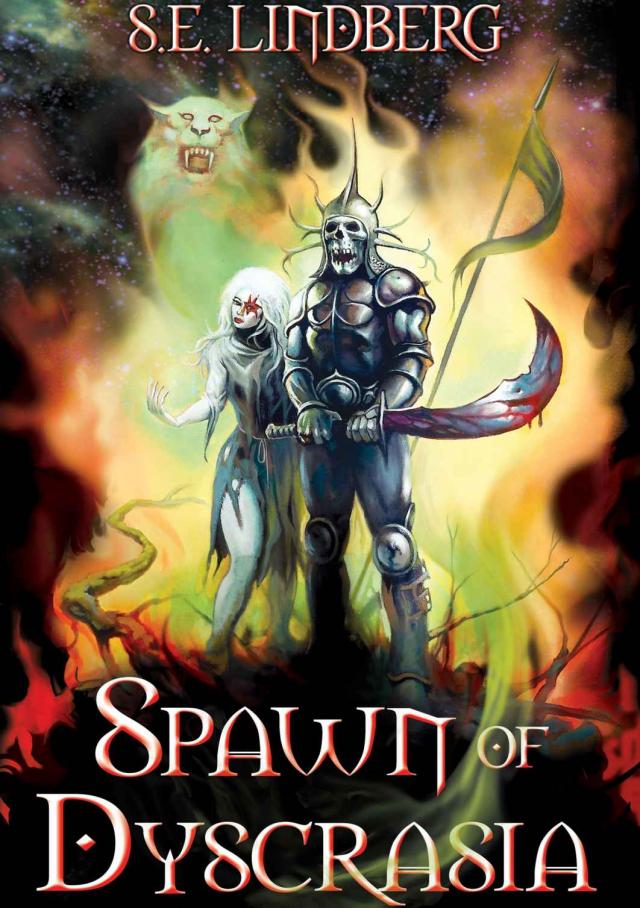


Spawn Of Dyscrasia
This is a work of fiction. Names, characters, places, and incidents either are the product of the creator’s imagination or are used fictitiously, and any resemblance to actual persons, living or dead, business establishments, events, or locales, is entirely coincidental.
No part of this book may be reproduced or transmitted in any form or by any means without written permission of the author. Reviewers may quote brief passages.
Spawn of Dyscrasia
Copyright © S. E. Lindberg 2014
Paperback: ISBN-13:978-0-9838262-3-1
ePub Kindle : ISBN-13: 978-0-9838262-4-8
Dyscrasia Fiction™ is a trademark of IGNIS Publishing LLC
IGNIS Publishing LLC
8064 Seabury Court, West Chester, OH 45069
The Morpheus Font is used with permission from Kiwi Media.
Front Cover Art © Ken Kelly 2013
Back Cover Art and Map © S. E. Lindberg 2014
Cover Design by S. E. Lindberg and H. L. Lindberg
Edited by Forrest Aguirre
Dedication
Undying thanks to Team Lindberg:
Art Director, Heidi
Resident Mythologist, Erin
Truth Teller, Connor
Therapists, Shorty & Sweetie
Map
Table of Contents
Dedication
Map
Table of Contents
I: A Standard Bearer Leaves the Keep
II: Death Rains on the Joyless City
III: Desecrating the Underworld Hollow
IV: Bog Battle
IV: The Final Imago Emerges from Tonn Tomb
Epilogue: Operating Theater Birth
The Ill Age
About the Author & Dyscrasia Fiction
Glossary
I: A Standard Bearer Leaves the Keep
Helen did not fit in.
She knew.
She trailed the other neophyte curators, shuffling through the tunnels. The golem, Doctor Grave, was assembling them for a sudden, unrehearsed ceremony. Although the Doctor governed the Chromlechon Keep, he was not its ultimate leader. He answered to two Gray Lords, the more reclusive of which was losing its healer and required a replacement. He led the parade of candidates to the amphitheater.
It was a solemn time, especially for Helen. A former acquaintance lay dying in the chamber ahead, and she mourned for her already. Distracted by thoughts of death, she had forgotten to fetch her banner. Irresponsible, she knew. Many rites required using it. Too late now. Maybe no one would notice. Better march forward ill-prepared than fetch it and be late. The other initiates proceeded in full regalia, and their unmarked flags swayed from staffs in front of Helen. Admittedly, they were more prepared for any ceremony than she was, but the occasion did not deter them from gossiping. They were less concerned about paying respects to the failing curator and more concerned about being selected to serve the lesser of the two Grays. They did not want to be here, but they would never question or delay the customs within the Keep. Helen found their chatter disrespectful:
“I wonder what she did to be sentenced to serve Lord Echo—”
“His next will become cursed like her—”
“Is her body contagious?”
“What was her name, anyway?”
The healer’s name was Sharon, Helen reflected as she fiddled with a silk ribbon to secure a braid. She would never forget receiving the tie. Even though Sharon had been Echo’s curer for as long as anyone could remember, and therefore isolated from the Keepers, the two had experienced the end of the Ill Age together. One never forgets the moment parents die.
Twenty years ago, Helen and Sharon were little girls. Sharon hailed from Clan Qual and often accompanied her parents to the highlands to purchase pelts from Helen’s family. She always hid behind her mother, caring for a rag doll. She was detectable regardless, since her hair was a luminous skein of orange curls. The sun’s rays seemed to get trapped within those curls, and grew more orange, as if enflamed. Sharon said little to nothing during these exchanges.
Sharon’s doll was attractive. Its dress was a weave of shiny, silk ribbons. Its glass eyes looked wondrously glossy. If not for their miniature size, they appeared life-like. Crafting those marbles surely involved magic, Helen had thought, and so the doll must be magical too.
Helen’s father, always encouraging adventures, wrapped Helen in a feline pelt and sent her and Sharon into the fields to play. Helen had been petite as a girl, and could enrobe herself entirely within the fur hood. Sharon followed, in awe of it. In Qual, all clothes had been hand-made, so Sharon could not conceive how the furry shawl was crafted. A cat and little doll chased each other, carefree in grass taller than they, until they heard a distant, urgent shouting.
I have not heard my father’s voice since then. Helen was not sure if she felt sad or proud for surviving so independently. Her mother had always called her by her formal name: Helena. She recalled them yelling to her and Sharon, frantically begging them to come back to the safety of their home. A black storm laced with fiery threads rolled from the west. Before the girls could return, the sky abruptly collapsed, and the cabin was engulfed in a volcanic cloud.
Sharon and Helen awoke in the fields. They found themselves coated in ash. The skeleton of Helen’s home smoldered. Playing in the fields had saved them from incineration. Parentless, they strayed together for days, roaming away from the devastation. Ignorance and exposure nearly killed them both. They would have died in the wilderness, had not magic intervened. A fairy cat, comprised of green embers, found them one night. The glowing parchment creature lured them southwest, toward the Keep. Who could deny such a divine calling?
They found beauty in wild flowers during their journey. These they picked. White lilies adorned Sharon’s red hair; red poppies decorated Helen’s white. To fix a braid from unraveling in Helen’s hair, Sharon took a ribbon off her doll and knotted it. It remained two decades later, carefully moved upward every several months as her hair grew. Several dozen small relics, like beads and small metal rings, have since joined it. Abject charms inspired her. Helen evolved into a collector of sorts, ever appreciating the power of items others deemed spent. Most items did not fit in her hair. These she squirreled away under the Keep’s crawlways in remote stashes.
Presently, she released her hands from the ribbon. She closed her azure eyes. Then she ran her fingernails against the flat hewn walls to ground herself in reality. She preferred the natural glossy surfaces of the lower strata than these carved walls gracing the tunnels nearer the surface. If she had ever to sacrifice a sense, it would be her hearing or sight. Taste or smell, perhaps. However, touch, above all, she would not relinquish. She would never give up the ability to feel.
She followed the others up the ramp toward the Operating Theater. It was time for them to adorn their flags in a ceremony. One would leave their apprenticeship under Doctor Grave, committing herself to official service. Helen had forgotten her flag, so she was going to have to improvise. As they funneled toward their seats, Helen broke from the line to sit apart. No one noticed her departure. They rarely sought her out anyway. Ironically, the others were dressed as if they wanted to participate. They all stood erect, wearing linen shifts overlaid with colorful waxen aprons and elbow-length gloves to protect their hands from toxic inks. Yet they did their best to look away: ‘Look upon the sickly and sickly you become,’ some said. It was no surprise that they did not look directly at the center stage either. Sharon lay there.
The Keepers had become accustomed to their present circumstances, putting aside the nightmares born from the cataclysm when the Gray Lords defeated dyscrasia. As the orphaned children of the Ill Age grew into adulthood, they created a new society of survivors within the Chromlechon Keep.
Helen was not inclined to conform. Her skin was ornamented with black splotches and splatters atop tattoos of cats, grasshoppers, and creatures from her daydreams. The darkness of these markings contrasted with the paleness of her skin and hair, which were oppositely-charged white. Her gaunt form belied her real age. Her boney shoulders slouched, and her collarbone hardly supported her ragged cat hide, which had been sized for a young girl, not a woman in her twenties. Her sacred pelt mantled her neck over the standard frock. She drew comfort in the memories continually seeping from it. A decade of wear had taken its toll. It resembled a mangled shawl now.
Helen turned her attention to the curator perishing at the center of the Theater. Oh, Sharon, it is has been so long since we talked. I have missed you as you ventured. I wish you could hear me say ‘farewell’. Sharon had served as Lord Echo’s lone inker for many years. None envied her, except Helen, perhaps, who deemed Sharon’s role as more interesting than deficient. The Gray Foundling was less glorious and less attractive than Lord Lysis, who acted as king over the Keep. Conceived from a union of eldritch creatures and man, Echo was born with a monstrous litter in which all his siblings expressed various combinations of avian, insect, and human traits. Unlike his winged Gallwraith kin, Echo first appeared predominantly human. As he matured, the hybrid shed his fleshy, larval shell and assumed the shape of a colossal humanoid resembling a mantis. A set of wings were furled back and out of sight, and even if extended probably could not support
Now, his four legs and thorax were plated pearly white, which made the pale flesh of his torso appear dark, in comparison. His arms bent awkwardly, his dangling hands poised to lash. Impossibly large eyes, glossy black globes, stared down at his servant. As she died, the Gray Foundling and his Guard, whom she supported, grew weak. He was faint from lack of inking. His head drooped, and he leaned on his reanimated guardian, Bryhan.
Echo and Bryhan appeared darker than the lantern light of the Theater would seem to permit. He needed treatment. Helen knew that Echo’s white blood merely hungered for power. His radiance would return to a white glow once satiated. After all, Doctor Grave had taught the Keepers the ways of alchemy and the history of the Lords’ rising. Helen recalled his teachings, which had been given in this very place:
“There are two basic rules you must understand,” the Doctor had professed from the Theater dais, his colossal cleaver in hand. “Two for now, anyway. The first is the Rule of Stone, which simply follows: hybrid blood always calcifies.”
Masked in flayed skin, the Doctor wielded his blade and approached two hanging cages. The cabinets and display of tools were compulsively clean and organized. Residual fluids on tools tended to react violently with other liquids, so Grave’s meticulous habits were warranted, lest the instruments be ruined. Rows of vials were banked on the shelves behind him, a stock he continually used and replenished. The glass jars held variegated chemicals both mineral and fluid, smoky and clear, sparkly and dull.
“When blood is stricken with dyscrasia, it has an imbalanced ratio of human and elder elements. This fluid is unstable and rapidly ossifies, especially upon contact with other diseased blood. Donations from our prisoners will illustrate the reaction.” Grave slit the femoral artery of a vampyric harpy, its wings already clipped and body stuffed into an iron gibbet so compactly that its feathery legs protruded from the cage. The fresh carcass shivered as it released its blue blood, filling a bowl beneath it. Then the Doctor moved the bowl beneath the other prisoner and cut its legs. Soon a blood of lighter shade splashed into the bath of vibrant ichor. All in the theater were awed as the mixing of impure blood issued sparks. The liquid lost its blue color with each electric discharge, leaving the dish filled with a gray rock.
“However, when blood has the proper eucrasiac balance—as is within the blood of our Lords—it becomes a white amalgam: lapis elixir. Like the luminous molten rock that spits from mountain cores, lapis elixir is a liquid stone. It looks like cream, though it flows as slowly as mud. This ichor is thick and cool to the touch. Do not let its temperature fool your perception of its power. It contains more energy than the celestial stars.” Then he ended the session. “Our lesson next month will describe the second principle: the Rule of Blood and Ether.”
Helen would never forget that second demonstration either. The Doctor had walked the perimeter of the chamber extinguishing all torches save the one on center stage. Here he retrieved his cleaver and placed it on the operating table. Disrobing from his apron, the Doctor bared his chest. His flesh was gray clay. He was humanoid in form, but was not truly human. An earthen scar the width of Lysis’ sword extended across his left breast. Silently, he turned the blade upright with his left hand and leaned forward. He did not flinch as the laceration opened anew. His flesh did not react as would human muscle, but split cleanly like fruit. He was known to be a golem, but, given his bipedal form and masked face, it was easy to overlook his inhumanity. Now his earthy composition was clear. Out from his flesh seeped lapis elixir, the white blood animating him.
The audience gasped.
“There are other rules, mind you, such as the Rule of Animation, which you will not master since possession is a skill beyond your purpose. Yet know this, the Lords reanimate we who would otherwise be lifeless.” He stood upright and pulled the clay flesh open with both hands. The golem’s homunculus heart was thus revealed, and its white ichor seeped out to bleed onto the torch. “Students, this blood is not properly mine.” Onto the final torch he directed his dripping wound. The fire struggled to breathe while being doused. Helen had thought it looked more like milk squeezed from a goat than it did fluid marble. “It belongs to Lord Lysis, who animates me.”
The Keepers sat still awaiting for the Doctor to collapse.
“Now initiates. Ink your flags. Think upon the power of Lord Lysis and the beauty he inspires you to create.”
All the neophytes, except for Helen, went to work. Within the hour, several dozen paintings were given form and color, only to have them drained of substance as the torch flared higher and higher. As was the case now, Helen had forgotten her flag then—a habit she was just beginning to exhibit. She remembered looking around in vain for a way to participate, but was unsuccessful, so she decided to act inconspicuous and wait the session out. The Doctor noticed her anyway. He stopped his rounds before her seat and stared at her with equal parts curiosity and incredulity. This ate away her esteem. In silence, Grave pointed to her arm, and walked off. He had prompted her to experiment. Apprehensively, she applied her inks to her arm. The marks faded instantaneously. It was then that Helen learned that flags were not necessary for magic to work. Any medium sufficed.
The group’s creative energies had fed the lapis elixir, and it glowed brilliantly. Soon the entire Theater was brightly illuminated by the blazing white light of a single torch. And their canvases were blank again.
“You have rejuvenated your master’s power and witnessed the Rule of Blood and Ether in practice,” Doctor Grave said. “It follows: blood is the medium bridging the physical world with the ethereal, body to soul.”
Grave had stood close to the lone fire. His mask cast a triangular shadow behind him. “Our Gray Lords animate their minions, cast spells, and perform sorcery by drawing on energy that is invisible to the living. It is the alchemical element called ‘ether’. The Lords and we undead see it as flowing prismatic streams, and there are as many colors as there are forms it can take. Experiencing that beauty is beyond the scope of your duty. Understand, this ethereal energy is the same that charges emotions and constitutes ghosts, memories. It is the enigmatic muse that inspires artists.
“Know this: blood is the medium in which this ether moves and is stored. When it has an imbalance of humors, it is diseased. It cannot accept or transmit more power than it had originally. As sorcerers and artists exercise creativity, they will deplete this source. Dyscrasiac blood can be drained, and does not replenish. The iron elements within it turns color, as you see it, from red, to blue, to a black oil. Blood is a like a water well, students. When diseased, it will run dry. The amount of sorcery is then limited by the amount of blood available. And thousands have been sacrificed. As the extinct elders grew sick and battled for life, we required amounts of energy that only large scale sacrifices could provide. This is why your parents died. They were sacrificed for the ether in their blood.”
He paused, seeing his audience collectively remember, seeing their memories reconstruct as crimson nightmares about them, visions of kidnapped fathers, impaled mothers in the blood bogs…
When they were ready to listen again, he continued. “The true victory of the Gray Lords was harmonizing the ratio of elements in their blood, ceasing the ill reactions to dyscrasia. This reversal was an outcome of Lysis saving the hybrid Echo from the Queen’s Forge. It was then that the alchemical elements of earth and ether were brought into balance.
“Ever since, expressing creativity enriches the blood of the Grays. They depend on your artisanal offerings for strength, but not your blood or the blood of others. The amount of energy provided is limited only by the emotive limits of your work. When they feed, the fiery ether of their blood changes, from black, to colored, to brilliant white. Blood is a like a water well, as I have said. When healthy, it can be refilled with rain.”
Then he used his cleaver’s hilt as a gavel, banging it into the table to focus everyone’s attention.
“This is your charge, as inkers and curators,” Doctor Grave proclaimed, “to empower your Lords. The beauty you create feeds their energy source. Your primary duty, will be to protect their blood. If they are cut in battle, bind their wounds as a curator. If they become drained of energy, empower them with your art.”






