

On spec summer 2014, p.1
On Spec - Summer 2014, page 1
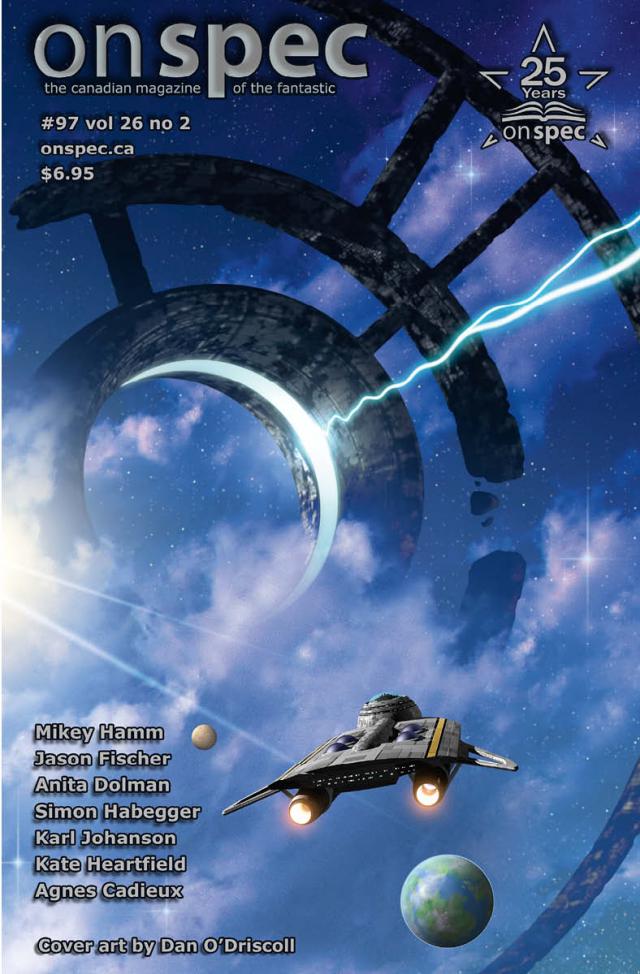


on spec summer 2014, vol. 26 no. 2 #97
Publisher: The Copper Pig Writers’ Society
Managing Editor: Diane L. Walton
Art Director: Diane L. Walton
Poetry Editor: Barry Hammond
Interior Designer: Jerry LePage
Cover Designer: Cat McDonald
Fiction Editors: Eileen Bell Barb Galler-Smith
Constantine Kaoukakis Ann Marston Susan MacGregor Diane L. Walton
Publisher’s Assistant: Jennifer Laface
Copyeditor & Twitter: Brent Jans
Cover Artist: Dan O’Driscoll
On Spec is published quarterly through the volunteer efforts of The Copper Pig Writers’ Society, a registered Alberta non-profit society. Full subscription rates (price includes GST) are on page 2 and 3 of every issue and at: www.onspec.ca/subscribe
Telephone: 780-628-7121
Email: onspec@onspec.ca
Website: www.onspec.ca
Mail:
PO Box 4727
Edmonton, AB
T6E 5G6
Copyright belongs to the author or artist by-lined, and no portion of this magazine may be reproduced without consent from the individual author or artist. On Spec is a licencee of Access Copyright. Writers, Artists and Poets, see our website for current submission updates and guidelines.
acknowledgements
The donors listed below have all given generously of their time and their money in the past year. We gratefully acknowledge their support.
sponsors & financial supporters
Publication and promotion of this issue have been made possible by financial assistance from Alberta Culture, Alberta Multimedia Development Fund. We acknowledge the support of the Canada Council for the Arts which last year invested $24.3 million in writing and publishing throughout Canada. Nous remercions de son soutien le Conseil des Arts du Canada, qui a investi 24.3 millions de dollars l’an dernier dans les lettres et l’édition à travers le Canada.
supporters & patrons
Danica LeBlanc, Jennifer Laface, Isaac Calon, Heather Price Ferguson, Laurie Penner, Brent Jans, Ashlin McCartney, Cat McDonald, Brandon Schatz, Gareth Boyce, our sustaining subscribers and volunteers. Our special thanks to everyone behind the Pure Speculation Festival, Clear Lake Ltd. and Jena Snyder for 16 years of dedication and support.
Newsstand Services (Distributor): Magazines Canada
Printing: Capital Colour in Edmonton, AB
Postage: Paid in Edmonton, AB
GST# 123625295
ISSN 0843-476X
© 2014 On Spec
Read the Digital Edition of On Spec!
On Spec digital singles and subscriptions are now available from Weightless Books!
$14.99 US for 1-year subscriptions of 4 issues
$3.99 US for a single issue
Formats include PDF, ePub and MOBI.
weightlessbooks.com/format/on-spec-magazine-1-year-subscription-4-issues/
More digital delivery services will be available in the upcoming months.
Keep in touch with On Spec!
Website: www.onspec.ca
Facebook group page: “I Read On Spec”
Twitter: @onspecmagazine
Sign-up for On Spec’s newsletter: http://eepurl.com/Xphf9
Comments and questions? Voice messages can be left for us at 780-628-7121, or you can email onspec@onspec.ca.
Thank you for your support!
non-fiction
One Third
Editorial by Cat McDonald
When I’m awkwardly trying to explain my reactions to a story, I condense it down to three core elements: the plot (the happenings that drive the story), the characters (the people who experience the events of the story), and the premise (the contextual platform on which the events of the story are based). A failure in any one of these elements will make it harder for the reader to enjoy the others and will cause the story, like a tripod with a short leg, to fall in on itself.
More than any other genre, fantastic literature banks on its premises, growing stories out of gods, demons, and spaceships rather than on the everyday trappings of the world. Fantasy premises are lovingly crafted, sometimes planned out for ages before the story itself is even written.
A good premise is a beautiful thing. When you learn about a world other than your own and find yourself wondering, “What would my life be like there? What kind of person would I be?”, the stories already begin to rise up in your imagination. Look at the Harry Potter series; how many fans proudly wear the scarves of their houses? The premise of Hogwarts inspired people, had children hoping for letters and adults busily knitting. After I played Persona 4, I stared out of train windows and wondered what my Shadow would say. If I were to join Starfleet, I’d likely be one of those art specialists you used to see in the original series, I think, but I know I’d never be a captain. The internet is full of people so moved by a work’s premise that they’ve written shelves of fanfiction, or started role-playing groups, to explore their own places in the worlds they love. When a fictional world gives that feeling of completeness, a person can’t help but imagine the other stories that go on there.
In designing a role-playing game, like my own Cabal Games’ upcoming City Limits, premise is everything. The game book lays out the rules and the world, and everything else is a strictly do-it-yourself affair. Ever since TSR published D&D’s first setting, Greyhawk, in 1980, role-playing games have come complete with worlds ready to be populated and explored, from the dystopian sci-fi comedy of West End Games’ Paranoia to the moody urban horror of White Wolf’s classic Vampire: The Masquerade. A good role-playing game provides a context that inspires the players and the Game Master (GM) to tell their own stories. Like any other game, it gives a framework for challenges—listen to a poker enthusiast if you’re wondering about a game’s ability to inspire stories—but it also adds premise. Combine that with the right people, and you can work together to build something amazing. Some of the stories my friends and I have told over dice still get repeated at parties years later. Premise has the power to inspire people.
Paranoia is a game that can best be summed up by asking “What if Orwell’s 1984 was a comedy?” Originally published by West End Games in 1984 and currently available from Mongoose Games, it’s a high-energy game about a dystopian future where Friend Computer controls every aspect of your life and, as a result, everyone is incredibly stupid. Friend Computer needs to protect Alpha Complex from Commies (and Mutants, and other assorted Traitors), and needs your help. Paranoia is characterized by a tightly-knit web of missions, secret goals, vendettas, and conspiracies that boils down to complete anarchy. The first time I ever played it with my friends, Shawn pushed Jimmy down an elevator shaft (for the crime of treason) before they even got their mission.
Vampire: The Masquerade is the game that crystallized the 90s Goth movement into a single role-playing experience. Released in 1991 from White Wolf Publishing, it lets the players act as vampires from a number of different clans, moving through political intrigues while trying to remain undetected by humans (the titular “Masquerade”). The characterization of the clans did something a lot like the houses of Harry Potter—would you be a sensitive, artistic Toreador or a rumbling Brujah? The setting was later expanded into the World of Darkness, including Changeling, Mage—and my favourite, Geist—but Vampire will always be the face of the line. I played it with my friends as an awkward teen, in a party where I was a fabulously wealthy lawyer whose cars meant nothing because the only one in our party who knew how to drive was crushingly insane and insisted on driving a rusted-out Civic he found in an alley.
In Legend of the Five Rings (currently available from Alderac Entertainment Group), the players are samurai in the rigid magical kingdom of Rokugan, navigating complex social rules and fighting for their lives against the influence of the Shadowlands. In Scion, a more recent White Wolf game, players are the children of classical gods and goddesses, using their superhuman powers to carry out the work of their divine parents in the real world. In our City Limits, magic has suddenly awakened in the world, and people from all walks of life are developing their own ways to control it. On the highest level of the military and government, agents are tested, trained, and given drugs to suppress the side effects of their new powers, while on the street people embrace their daemons and live new lives as symbiotic hosts.
In a good role-playing game, you provide one-third of the storytelling—your character’s role, actions, and personality. Your GM provides the plot, the game provides the premise, and together you assemble a story. It’s like a sundae bar of great fiction, where you can take a long look at all the pieces of a story, put them together however you like, and sit down with good friends to enjoy it.
Like all the best things in life, a story is too good a thing not to share. So, next time you feel yourself wondering about your place in a fictional universe, try looking up a good RPG. Maybe you’re just holding one third of your story.
You can visit Cat and the rest of the Cabal Games team at www.cabalgames.ca, or on Twitter @TeamCabalGames. ▪
In Memoriam
Space
Joseph Edward “Jay” Lake, Jr.
June 6, 1964 – June 1, 2014
“The Oxygen Man” appeared in On Spec’s Winter 2003 issue.e
Daniel Keyes
August 9, 1927 – June 15, 2014
Frank M. Robinson
August 9, 1926 – June 30, 2014
fiction
Bugzapper
It was the princess from the energy tenser thing. Joshy had almost broken out in hives the first time he met her.
Mikey Hamm
Joshy’s summer had been pretty good. He had gone camping, written his learners’ exam, and broken the sound barrier with nothing but a pair of apocalypse-powered jet shoes, a narrow-band frequency scatter-hedge, and a few lines of code.
A scatter-hedge deflects selected kinds of energy, allowing you to crank a pair of jet shoes up without liquifying the lower half of your body. That will get you close, but if you really want speed, you need to know when to crank them. The code does that. It analyzes the quasi-existent vibrations the multiverse is allegedly made of, and triggers the shoes during each phase dip, allowing you to skip along the surface-tension of your dimension, as long as you live in a fairly tight dimension. If you live in a baggy dimension like Earth’s you need an energy tenser, which Joshy had been awarded by a meta-terrestial princess for stopping a marauding army of trigger-happy planar fugitives named Nathan.
Yep, it had been a pretty good summer and fall was fading in beautifully, but that didn’t stop Joshy from being Joshy. He was in the garage attic, tearing through cardboard boxes and Rubbermaid bins, muttering to himself, losing his mind. Losing it fully. His best friend, Doug, was eating ketchup chips while watching him fully lose it. Every time Doug would find a place to sit, Joshy would need him to move so he could look there.
“Just tell me what’s wrong,” said Doug, between chips.
“It’s nothing,” said Joshy, trying to open a trunk that was still Doug’s chair.
“Just tell me,” said Doug.
“Just get up,” said Joshy.
Doug crunched a chip, and didn’t get up.
“Fine,” said Joshy. He sat down on a bin, “I like this girl.”
“Gross,” said Doug.
“We’re fifteen, Doug.”
“Fine,” said Doug. “Who is she?”
“She’s cool.”
“Who is she?”
“She’s really smart.”
“Is she hot? Who is she?”
“And super funny. And really smart.”
“A smart, funny, cool ghost with no physical existence or name. Got it.”
“Doug.”
“Just tell me who it is and if she’s hot!”
“She’s cute, yes. She’s got black hair that kinda, you know, tumbles out from under her crown and—”
Doug groaned.
It was the princess from the energy tenser thing. Joshy had almost broken out in hives the first time he met her. She was on the back of a celestial mare, holding a battle sceptre. She had face freckles, shoulder freckles, and black hair that kinda, tumbled, out from under her crown. Smart, funny, cool. Joshy knew that other-worldly nobility was probably out of his league, but he really liked her.
“I really like her.”
“Well, she’s out of your league and you’re out of your mind.”
“Well, you like that girl from the bible college. She’s out of your league.”
“Gross.”
“Doug.”
“Fine. But at least the girl I like has length and width and depth,” said Doug, mouth full of chips.
“Rani has length and width and depth, too. And possibly something called whenth, but that’s one of the possibly-there things I really like about her!” said Joshy.
Doug stopped chewing. “Rani?”
“Yeah,” said Joshy. “That’s her name.” He looked down at the smooth cylindrical energy tenser hanging around his neck.
Doug looked at Joshy looking at the energy tenser. “Cool name.”
“Yeah,” said Joshy.
Doug got up off the trunk. Joshy opened it and started rummaging.
“So, are you gonna tell her you like her?” asked Doug.
“She’s coming over tomorrow.”
“Tomorrow? To your house?”
“No like, over to our dimension. She wants to watch the planar eclipse and our meta-position allows for max-spectrum crystallization.”
Doug licked some ketchup dust from his thumb. “So, not to your house?”
“No,” said Joshy, “the park.”
“Which park?”
“I don’t know,” Joshy mumbled. “The one by the road by the glass store.”
“Make-Out Park?” asked Doug, with a max-spectrum grin.
“Shut up.”
“Sorry,” said Doug, “I meant Suicide Park.”
“Shut up, Doug!”
The park had an official name that none of the kids in town knew, and two nicknames that none of the adults in town knew. Neither of the nicknames was very good. But it was Rani’s favourite Earth-place.
“Why there?” asked Doug.
“It’s Rani’s favourite Earth-place.”
“Well, is she sure?”
“I don’t know.”
“Well, does she know about the bugs?”
“I guess not.”
Mosquitoes and horseflies. The park was full of them. Fewer birds meant more bugs.
“Well, does she know about the bloodwhips?”
“I guess not, Doug!” Joshy yelled, his arms buried in a bin full of electronics.
Level-Four Abyssal Bloodwhips. That was Joshy’s fault. It had happened by accident when he was fighting all the Nathans. See, the Nathans were actually just thousands of alternate instances of one guy named Nathan, which had actualized when he overdosed on something called cauchy. Picture a deck of cards, and you’re the top card. The other cards are you too, just different potential versions of you. Normally, the deck is stacked, so that you can’t even see the other cards. But a cauchy overdose or a quantum frame-divider fans the cards all out. Presto chango, a whole lotta Nathans.
To deal with them, Joshy had designed an envelope ray with a pretty standard causal switch attached to it. It shot a bubble of space around someone, and then switched them back, dimensionally-speaking. All he had to do was hit the original Nathan, flip the switch, and fold him back up. The original Nathan always shot first.
The problem was that the switch switched anything in the bubble. In this case, a stray bloodwhip. So he had one Nathan, but also a thousand bloodwhips. Joshy had tried to flip it back, but the original bloodwhip must have left the bubble, because all Joshy did was frame-divide two or three of the copy bloodwhips into two or three thousand and, long story short, Make-Out Park was now home to three thousand bloodwhip copy-copies, one thousand bloodwhip copies, and one original bloodwhip that Joshy couldn’t figure out how to find, even if his parents hadn’t told him to throw out the envelope ray, which they had.
***
Despite their cutesy name, abyssal bloodwhips are actually pretty gross. They’re like flying tapeworms. They have a series of combination heart-stomachs, mate for life, and can scream, usually when frightened or about to fly in for a tasty marrow bore. Bloodwhips subsist primarily on marrow, and the bloodwhips in Make-Out Park had been subsisting primarily on bird marrow.
“Bloodwhips are actually pretty gross, Joshy.”
“I know, Doug.”
“They drink marrow, right?”
“Primarily.”
“So why are you taking her there?”
Joshy pulled a silver spool of scatter-hedge filament from the bottom of the bin. “Because I have a plan.”
“What’s your plan?”
Joshy didn’t answer. He was staring at the spool.
“What’s your plan, Joshy.”
Joshy stood up. “I’m gonna tell her I like her in the park. When the planar eclipse is cresting.”
“When what?”
“When it gets romantic.”
“Gross.”
“Doug.”
“Well how long will that take?”
“I don’t know,” Joshy paced with the spool. “Like, an hour and 23 minutes.”
“That long? Are you stupid? Just tell her you like her right away. At the beginning. So you can like each other the whole time.”






